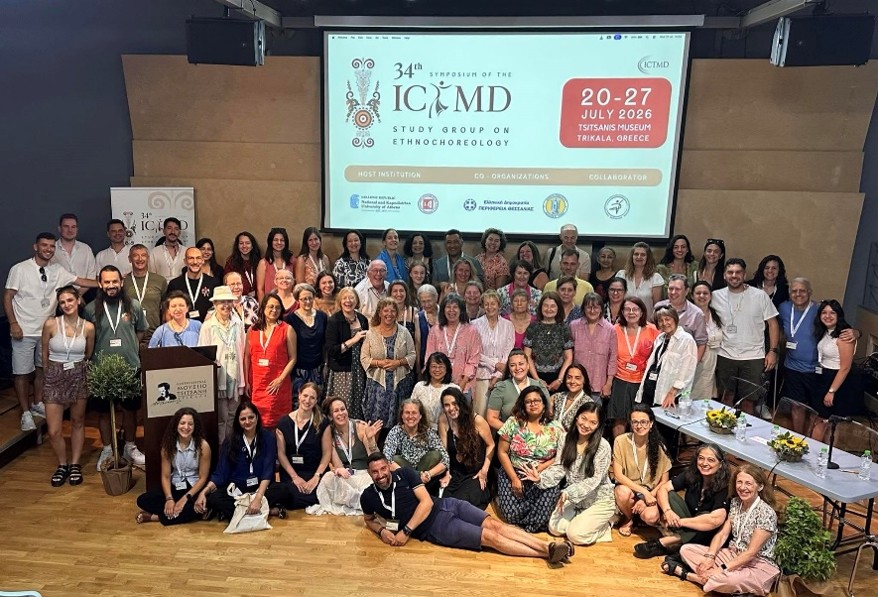
The International Council for Traditions of Music and Dance (ICTMD), an organization with a history of nearly 80 years and a founding member of UNESCO’s International Music Council, held its annual conference this year in Trikala, Greece, welcoming participants from Hungary as well.
Dr Henrik Kovács, a folk dance educator and Associate Professor at Hungarian Dance University, took part in the conference as both a panel speaker and a member of the Programme Committee. You can read his report from the conference below.
The conference organisers accepted our panel presentation titled “The Migration of the Motion: An Experimental Comparative Research among Greek and Hungarian Ethnic Groups”, which was submitted together with László Felföldi and Athina Androulidaki.
The presentation marked the first step in a long-term research collaboration comparing the structure and movement motifs of Greek and Hungarian folk dances. In my presentation, I analyzed the motifs of one Greek and one Hungarian circle dance. Following the traditions of Hungarian folk dance research, I prepared Labanotation transcriptions from video recordings and carried out a structural analysis of the dances.
It was a great honour that the organizers selected our panel as one of the conference’s closing presentations. During the discussion that followed, we received a great deal of positive feedback, which reinforced the importance of the research-based education offered at Hungarian Dance University.
I was honoured to be invited by the ICTMD leadership to serve on the conference’s Programme Committee. As the only Hungarian member, I had the opportunity to contribute to the planning of the conference’s scientific programme.
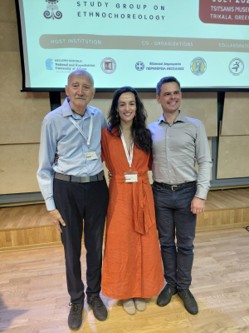
The conference also gave me the chance to promote Hungarian dance culture. During the World Dance evening, I taught Moldavian circle dances to participants from around the world.
The breaks between sessions provided valuable opportunities to meet leading international dance scholars, and these conversations were a great source of inspiration. The international recognition of Hungarian Labanotation education was also evident, as I received invitations from universities in the Czech Republic, Greece, and Türkey to lead professional training courses. At the same time, many early-career researchers approached me with questions about their own work.
In her closing remarks, ICTMD President Placida Staro paid tribute to János Fügedi, who passed away last year and played a significant role in the organization for many years.
The conference offered a rich and varied programme, providing many memorable experiences. We attended traditional folk dance performances, a rebetiko concert, Greek and international dance evenings, watched a dance documentary, and visited the Meteora monasteries, one of UNESCO’s World Heritage Sites.
I would like to express my sincere gratitude to the Grant Office of Hungarian Dance University, the Committee for Conference Participation Grants, and the Hungarian Bureau for the Protection of Performers’ Rights (EJI) for their financial support. Their assistance was essential in making my participation in this internationally significant event possible.
Dr Henrik Kovács